The Blog
Thoughts on privacy, AI, and building tools that put people first.
How to check if a PDF is really redacted
Check a redacted PDF for recoverable text, missed identifiers and hidden data before sharing it. A practical review routine, with the limits of each check.
Where personal data hides in a repository
Nobody commits customer records on purpose. Here are the nine places they arrive anyway, how to find them, and why a pattern search will not.
The AppImage that launched and rendered nothing
Velum 0.14.0 opened an empty window on Arch, with no error a user could see. The cause was four libraries we did not mean to ship, and the fix had to avoid a worse regression.
The case for local AI processing
On-device inference is no longer a downgrade. What that changes for anyone handling regulated data, and what it does not.
How Velum detects personal data without a cloud
The three detection levels Velum ships, what each one costs you in speed and size, and the residual leak rate we measure.
Does Claude Code send my code to Anthropic?
Yes, and the useful question is which parts, for how long, and who can read them. What the documentation actually says in August 2026, and how to send less.
Why privacy-first architecture wins
Retrofitting privacy onto a system that was never designed for it is a tax on every feature. Designing for it is a forcing function.
Velum vs Microsoft Presidio: a framework and a product are different answers
Presidio is an excellent open-source PII framework for engineering teams. Velum is a product a person can use. Here is an honest map of which fits when.
PII redaction extensions for AI chat: the field, honestly surveyed
Six browser extensions promise to strip personal data from your prompts. We make one of them, so here is a survey you can verify claim by claim.
Cloud DLP APIs vs on-device masking: what the architecture decides for you
Google and AWS both sell serious PII de-identification APIs. Whether they fit depends on one architectural fact: your raw text is processed in their cloud.
Introducing Velum: masking before the model, not after
Why we built a tool that masks personal data on your own machine before it reaches an AI, and what it does and does not promise.
Can I paste client data into ChatGPT?
Usually not on a personal account, and rarely for the reason people check. What the training setting does not cover, and what to do instead.
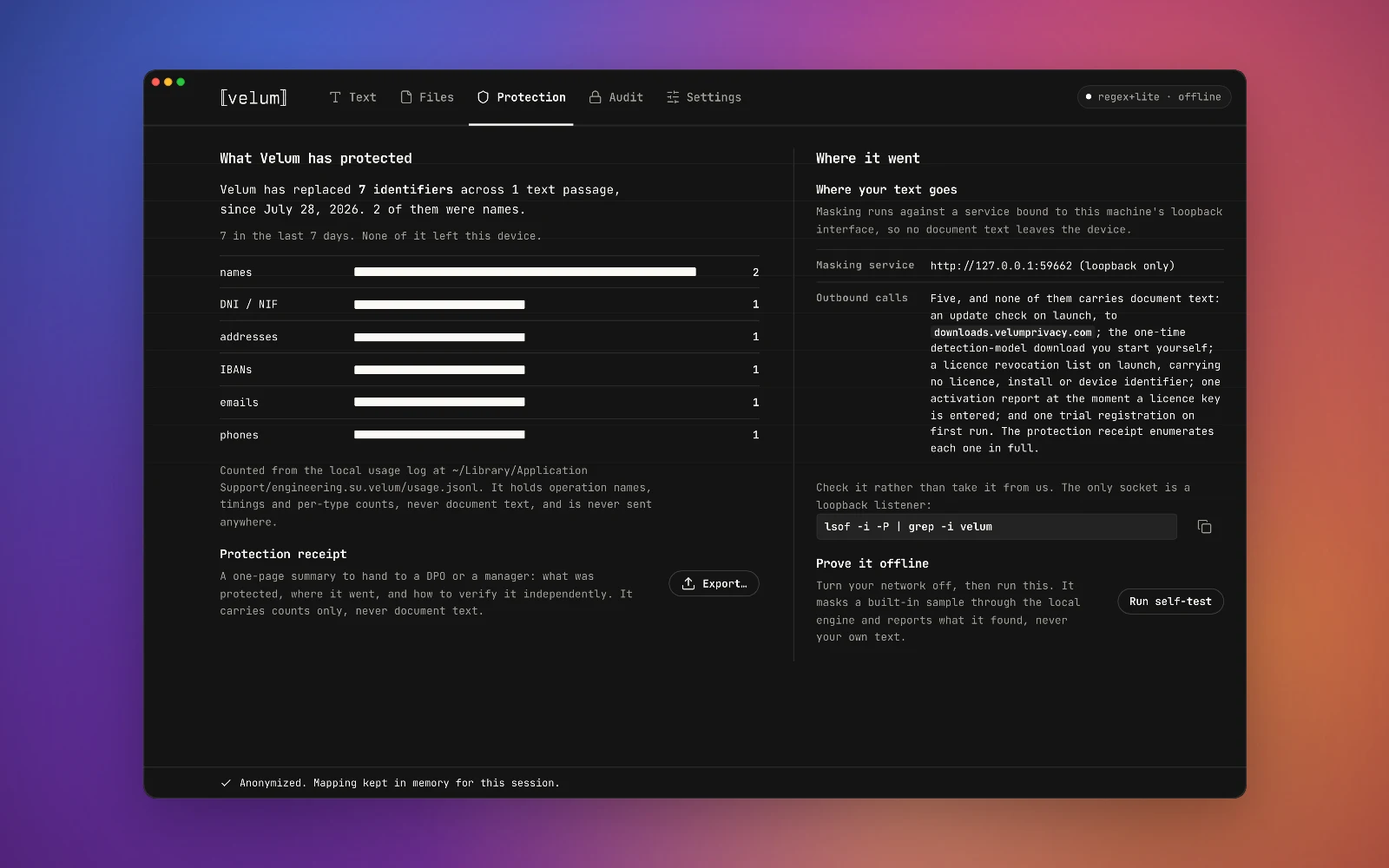
Velum 0.12.0: the right model for the file in front of it
Maximum is no longer one engine. Source files are read by one model, documents by another, because they fail in different places. Plus a date-of-birth bug we are glad we found first.
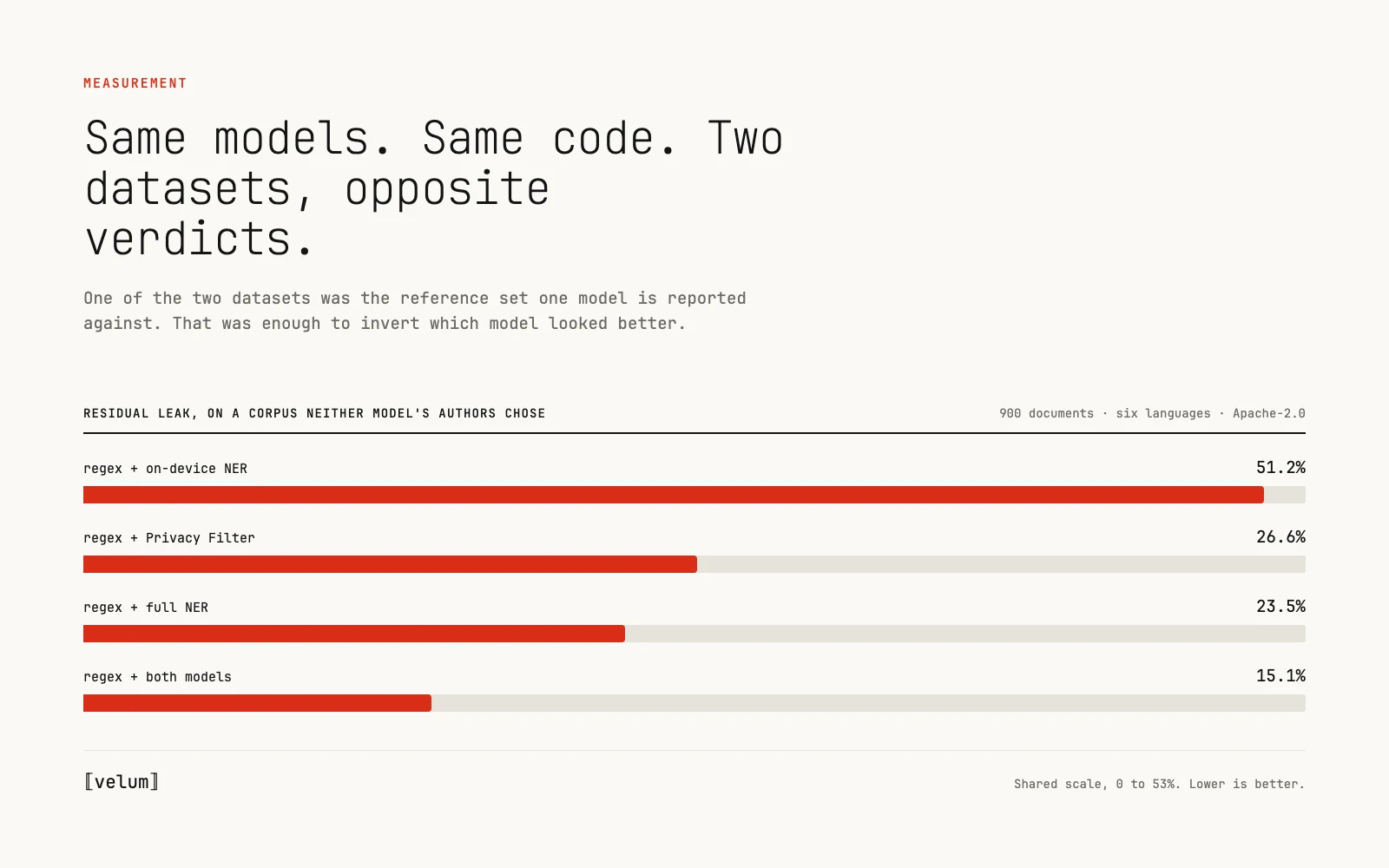
Our PII model comparison reversed when we changed the dataset
We measured two PII detection models against each other. On the first corpus, one won by three to one. On a corpus neither model's authors had chosen, the ranking flipped. The first corpus was the reference set one of the models is reported against.
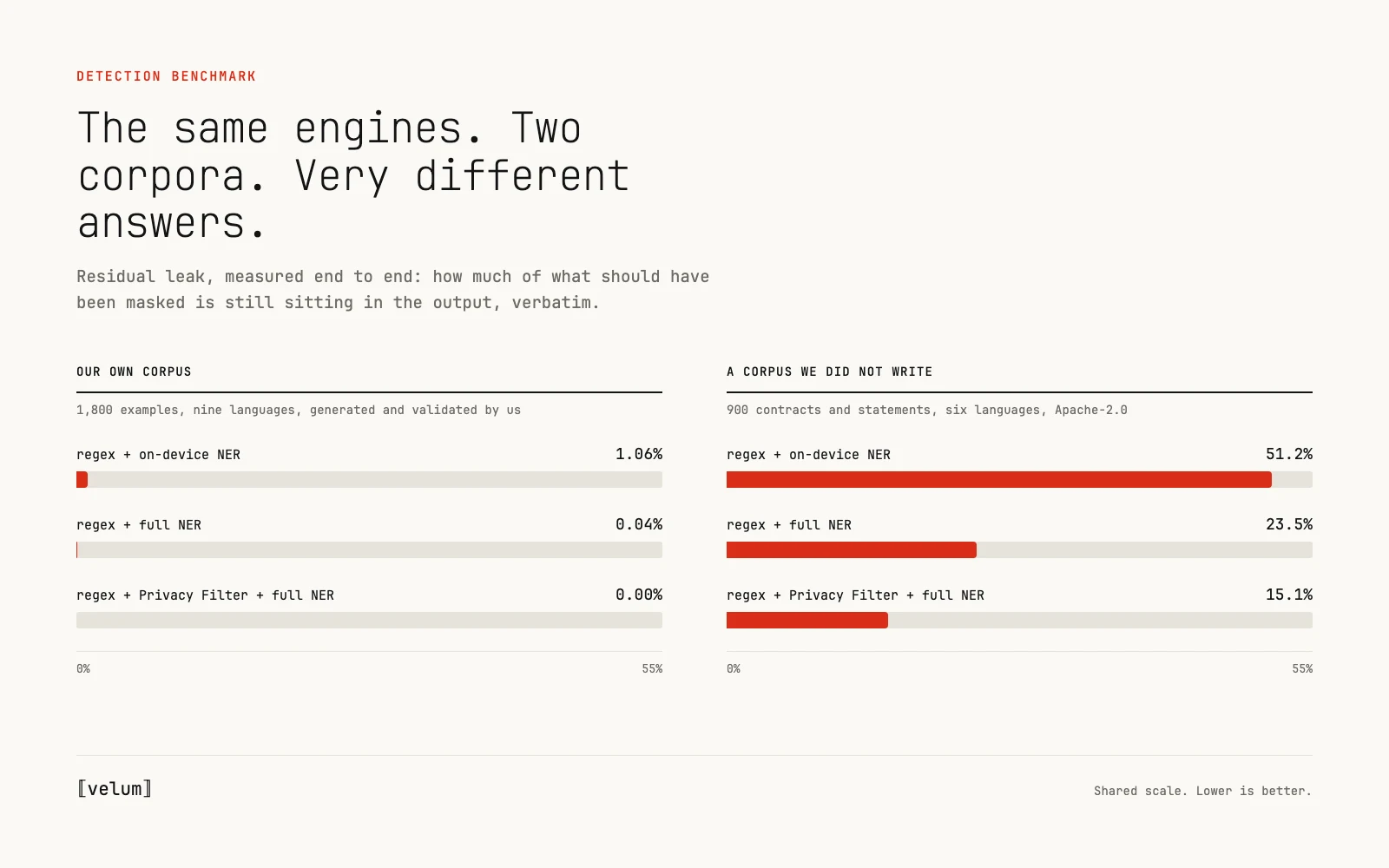
We benchmarked OpenAI's Privacy Filter. It changed our detector, and our benchmark.
OpenAI released an open-weight PII model. We measured it against what we already ship, on three corpora. The result was not the one we expected, and the reason is worth more than the number.
A 5-minute privacy check before pasting into any AI
A short, repeatable routine to run in your head before you paste into a chatbot, so personal data gets masked first instead of stored somewhere forever.
Auditability as proof: why a privacy tool must be readable
A closed binary can claim your data stays local, but you cannot verify it. Readable source turns a privacy promise into evidence you can inspect.
Anonymisation, pseudonymisation, tokenization: which one you actually have
Four words used as if they mean one thing. Only one takes data out of GDPR scope. What each promises, and how to tell what a vendor is really doing.
Velum Lite is on the Chrome Web Store, and the zip is gone
Installing the extension used to mean a 151 MB zip and developer mode. It is now one click from the Chrome Web Store, and the zip is gone.
What 'your data never leaves your machine' really means
Private and secure are marketing words. Here is the real difference between encryption you have to trust and processing you can check yourself.
A grep for fetch() is not proof your app is offline
Velum makes five network calls. Here is what our own offline checks catch, what they cannot catch, and how to verify the claim from outside the binary.
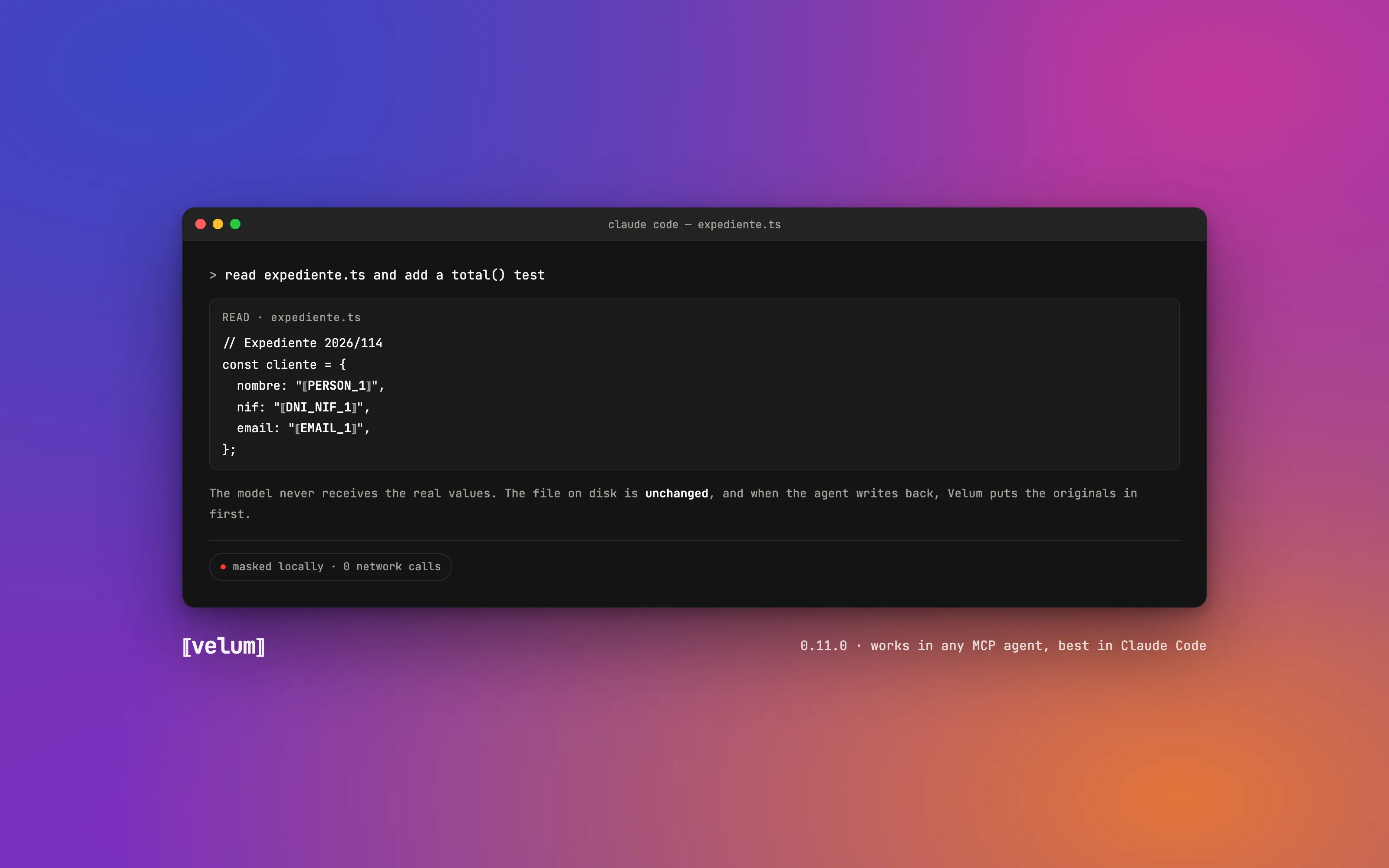
Velum 0.11.0: your coding agent reads masked files
An AI coding agent reads whatever is in the repo: names in fixtures, a tax ID in a seed file. Velum 0.11.0 masks it all before the model sees it.
The model that wins our PII benchmark loses on messy text
Our best detection chain leaks 0.07% of spans on a clean gold set and 8.3% on messy real text, where a cheaper chain beats it. The whole benchmark.
Masking files, not just text: contracts and PDFs
The worst leaks are not a sentence pasted into a chatbot. They are whole files: contracts, client records, medical notes. Here is how file-level masking works.
Velum 0.9.0: permanent redaction
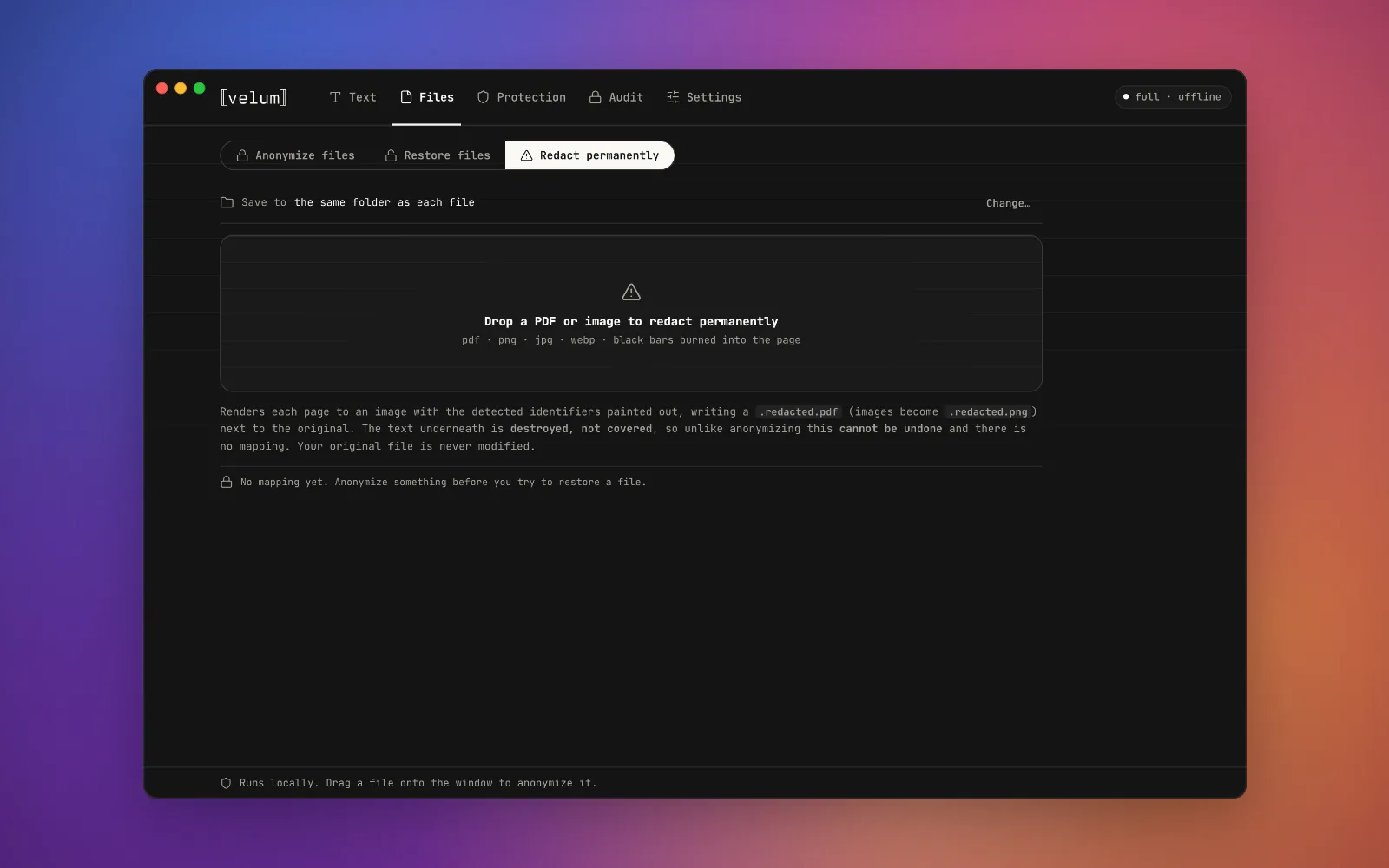
Drawing a black box over a PDF does not remove anything. The words stay in the file, still selectable and still copyable. Velum 0.9.0 destroys them instead.
Masking protects your data. Cleaning the file cuts your tokens.
Masked Markdown instead of a raw PDF costs 65 to 90 percent fewer input tokens. The privacy comes from masking, the saving from dropping page images.
Tokenized vs pseudonymized masking, explained
Velum masks data two ways before it reaches an AI model. Learn how tokenized and pseudonymized masking differ and which one fits the job you have.
Your prompts can become training data
People assume a chatbot chat is private. Many consumer AI tools may keep what you type, let humans review it, and use it to train. Here is the safe rule.
The hidden risk of cloud PII scrubbers
Many tools promise to strip personal data before it reaches the AI, but they do the work in their own cloud, which means they see your raw data first.
Why one-way redaction breaks your AI answers
Blacking out data keeps it safe but ruins the reply. Reversible masking swaps private details for placeholders, then restores them, so the answer stays useful.
The GDPR fines that should worry every firm using AI
Regulators are issuing huge GDPR fines for mishandling personal data, and AI tools open new ways to leak it. Here is the scale, and the simple fix.
GDPR and AI chatbots: where prompts cross the line
Pasting another person's data into a public chatbot can be unlawful processing or an unlawful transfer under GDPR. Here is where a prompt crosses the line.
What counts as personal data in an AI prompt
A plain guide to spotting personal data hiding in everyday AI prompts, from names and emails to small facts that together identify a real person.
The day Samsung banned ChatGPT
How confidential code and meeting notes leaked into ChatGPT at Samsung, why a single prompt cannot be taken back, and the simple fix that prevents it.